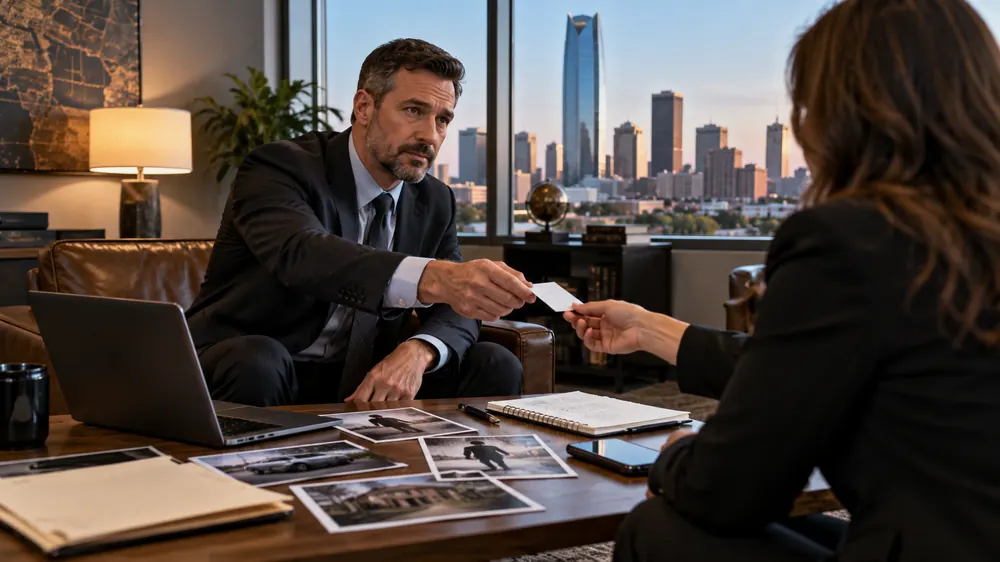
Consult: what happens on the first call?
The first step is a consultation, and it is free and confidential. You call, text or open a case file online, describe the situation in general terms, and Daniel tells you plainly whether it can be investigated lawfully and how.
Calls and texts are answered 24/7. The consultation can be a phone call, a video call or a meeting in the Oklahoma City area, arranged privately. There is no public office to visit.
A consultation commits neither side to anything. Fuller Investigations may decline a matter, for example because of a conflict of interest or an improper purpose.
If texts or voicemail are not safe for you, say so on the first call, and only the contact method you choose will be used. Please do not send photos, documents or sensitive details by text before the first conversation.
If someone is in danger right now, call 911. Fuller Investigations is not an emergency service.
Plan: what can lawfully be done, and what sets the cost?
The second step is a plan. Daniel sets out what can lawfully be done to answer your question, what cannot, and which methods fit.
The plan also covers cost. Fuller Investigations does not publish rates, so no figures appear on this page. Three things set the price of a matter:
- Time
- Investigator time, by the hour. In most matters, hours are most of the cost.
- Mileage
- The driving the work requires. Records research needs no travel at all.
- Records fees
- Database or records fees, where a search or a copy carries a charge.
Your cost is set out in a written agreement before work begins. The cost guide explains each factor.
Process serving is priced on its own. Under Oklahoma law, a private process server's fee is agreed between the server and the client (12 O.S. § 158.2), so call for a quote.
Engage: what has to be in place before work begins?
The third step is a written agreement and a retainer. No work begins until the agreement is signed and the retainer is paid.
The agreement sets the scope of the work and its terms, including how time, mileage and records fees are billed. The retainer is an amount paid before work begins, and time and costs are billed against it under the agreement.
Until then you are not a client, and neither side is committed to anything. Calling, texting, booking or having a consultation does not start an engagement.
Work: how is the investigation carried out?
The fourth step is the work itself. Daniel carries it out personally, by lawful methods only. Depending on the plan, that means:
- observation and photography from public places, the method behind surveillance;
- research in public records, and in licensed databases used for permitted purposes;
- interviews with people who are willing to talk;
- field checks that confirm what the records suggest, such as a current address.
Field work is recorded in a time-stamped log, and the report is written from it. While the work is under way, you are contacted only in the way and at the times you chose.
Report: what will you receive?
The last step is the report. You receive:
- a written report of what was done and what was found, with dates, times and places;
- photographs and video, where the work involved field observation;
- time-stamped logs of that field work;
- Daniel, available to testify about the work performed if the matter goes to court.
Work done from records alone, such as a background investigation or a locate, produces a written report without field footage.
The report states what was found, including when that is nothing. Oklahoma law bars a licensed private investigator from willfully making a false report to a client (59 O.S. § 1750.8(B)).
How a report is used in court is a question for your attorney.
What will Daniel not do?
Daniel will not break the law to answer a question, and says so on the first call. Oklahoma and federal law draw these lines, and Daniel works inside them.
Oklahoma's stalking law treats tracking a person's location with a GPS or other monitoring device, without that person's consent, as "following", with narrow exceptions. 21 O.S. § 1173
Daniel does not place trackers on vehicles.
In Oklahoma, a person who is part of a conversation may record it, and so may someone who has the prior consent of one participant, unless the recording is made to commit a crime. 13 O.S. § 176.4(5)
Surveillance reports from Fuller Investigations include photographs and video, not audio of other people's conversations.
Intercepting other people's conversations outside those exceptions is a felony in Oklahoma. 13 O.S. § 176.3
Secretly watching someone at a home or another place where they expect privacy, or secretly photographing them there, can be a crime. 21 O.S. § 1171
Surveillance stays in public places.
Willfully entering someone's yard, garden, pasture or field after being told not to, or without the owner's permission, is an offense in Oklahoma. The statute has no exception for investigators. 21 O.S. § 1835
Getting someone's phone records by lying to a phone company is a federal crime. 18 U.S.C. § 1039
Getting someone's bank information through false statements is a federal crime, with a narrow exception for licensed investigators collecting court-ordered child support. 15 U.S.C. § 6821
Public records can show signs of assets, such as property and business filings. They do not show bank balances.
Oklahoma's Computer Crimes Act makes it a crime to access another person's computer, account or data without authorization, or to ask someone else to. 21 O.S. § 1953
Daniel does not obtain another person's texts, call records or account contents.
A private investigator may not suggest any connection with a government or law enforcement. 59 O.S. § 1750.9(B)
Daniel never poses as a police officer or a government official.
Nothing on this site is legal advice. Ask your attorney how the law applies to your situation.
Research from Fuller Investigations is not a consumer report. It is not used to decide whether someone is hired, rented to, insured or given credit. Fuller Investigations declines any matter whose purpose appears to be to harass, threaten, stalk or harm someone.
What a private investigator can and cannot do in Oklahoma takes each of these lines in turn.
What should you have ready for the first call?
Less than you might expect. You do not need all of this, and you do not need documents in hand:
- the question you need answered, in a sentence;
- the names of the people involved;
- the dates, places and vehicles you already know about;
- any deadline, such as a court date;
- your attorney's name, if you have one;
- the safest way and time to reach you.
Each of the sixteen service pages has its own list for that kind of matter.