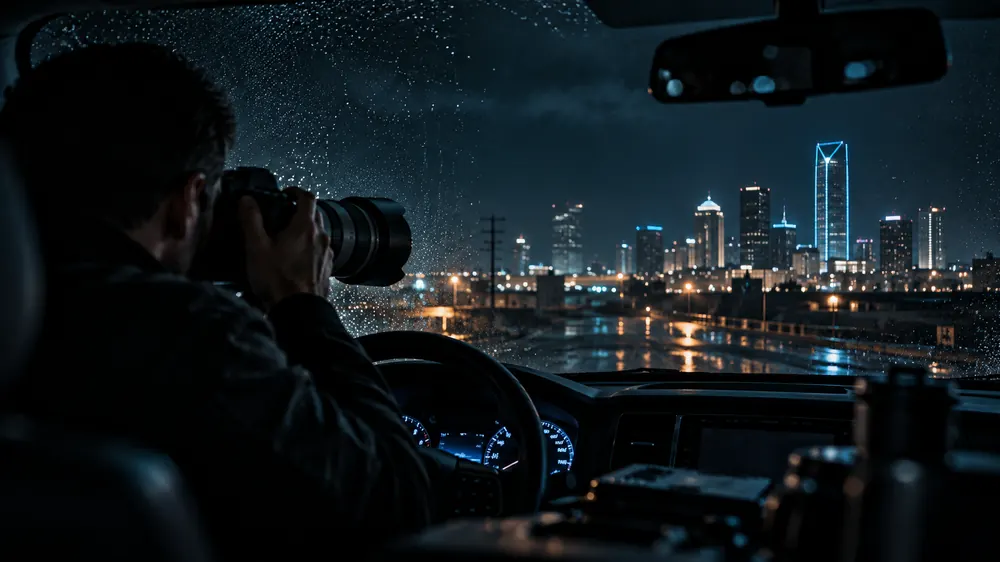
When does surveillance help, and how is it done?
Surveillance helps when a question turns on what someone does, where and when, and the answer can be seen in public. Daniel plans time windows around what you know, watches from public places and records what happens.
- A relationship concern: infidelity investigations.
- Parenting time: child custody investigations.
- An injury or workers' compensation claim: activity check investigations.
- Time or conduct away from the workplace: employee misconduct.
Stationary surveillance watches one place. Mobile surveillance follows a person between places on public roads.
Daniel works alone, so mobile surveillance is planned around schedules, routes and likely stops. Heavy traffic, fast driving, rural roads and places with many exits can mean a lost contact and a repeat window. Daniel does not drive unsafely to keep up.
Some windows show nothing. The report says so. A quiet period is a real result, and the plan can be adjusted with you.
Who asks for surveillance?
People who need to know what a spouse, partner or co-parent does in public before making a decision. Attorneys and insurance adjusters who need documented observation on a case or a claim. Employers with a concern about conduct away from the workplace.
Daniel Fuller is the only investigator and works every window personally.
What is lawful surveillance in Oklahoma, and what is not?
Observing and recording from public places is the method. Watching into private places, trespassing, GPS tracking and recording other people's conversations are not part of it.
| Daniel does | Daniel does not |
|---|---|
| Observe and photograph in public places | Watch or film into homes, hotel rooms, restrooms or other private places |
| Follow a vehicle on public roads at a safe distance | Place GPS trackers |
| Note times, places, people and vehicles | Enter yards or property without permission |
| Record video without audio of other people's conversations | Record conversations Daniel is not part of |
| Keep the original photo and video files | Contact or confront the person observed |
Secretly watching someone at a home or another place where they expect privacy, or secretly photographing them there, can be a crime. 21 O.S. § 1171
Willfully entering someone's yard, garden, pasture or field after being told not to, or without the owner's permission, is an offense in Oklahoma. The statute has no exception for investigators. 21 O.S. § 1835
Oklahoma's stalking law covers willful, malicious and repeated following or harassing that would frighten a reasonable person and does. It treats tracking a person's location with a GPS or other monitoring device, without that person's consent, as "following", with narrow exceptions. 21 O.S. § 1173
Daniel follows by observation only and does not place trackers on vehicles.
In Oklahoma, a person who is part of a conversation may record it, and so may someone who has the prior consent of one participant, unless the recording is made to commit a crime. 13 O.S. § 176.4(5)
Intercepting other people's conversations outside those exceptions is a felony in Oklahoma. 13 O.S. § 176.3
Surveillance reports from Fuller Investigations include photographs and video, not audio of other people's conversations.
Nothing on this site is legal advice. Ask your attorney how the law applies to your situation.
What do you receive from photo and video surveillance?
- A written report of what was done and what was seen.
- A time-stamped log: the date, the start and stop times, the place, what was seen, the vantage point, the weather and the light.
- Photographs and video, each with its date and time. Video runs continuously, and nothing is cut to change its meaning.
- The original files, preserved.
- Daniel, available to testify about the work performed.
Whether a recording is admitted is for the judge. Oklahoma's evidence code asks for evidence that an item is what it is claimed to be. Testimony from a witness with knowledge is one way to give it (12 O.S. § 2901).
That is why Daniel keeps the log and the originals. How the material is used in your case is a question for your attorney.
What should you have ready, and what affects the cost?
The first consultation is free. Work begins only after a written agreement is signed and a retainer is paid, as how it works explains. For the first conversation, it helps to have:
- a recent photograph of the person;
- the vehicles involved, with plate numbers;
- the addresses that matter;
- the schedule, as far as you know it;
- the question the surveillance should answer.
What it costs depends mostly on hours: how many surveillance windows, and how long each one runs. A predictable schedule needs fewer of them. Travel and mileage from Oklahoma City, preparing the video and any testimony are the other factors. All of it is set out in the written agreement before work begins. The cost guide explains each one.
When should you call the police or 911 instead?
If someone is in danger right now, call 911. Fuller Investigations is not an emergency service.
Surveillance records what happens. It does not protect anyone. If you are being followed, threatened or harassed, or a child is in immediate danger, call the police first.
Fuller Investigations declines any matter whose purpose appears to be to harass, threaten, stalk or harm someone.